Category Archives: Politics?!

Town investigation underway after Fowler trustee accused of racist social media comments

The town of Fowler has commenced an investigation into Trustee Shaun Luttrell after he was accused of racist comments on the Rocky Ford Word of Mouth Facebook page on Friday.

Editor’s Note: This story was reported in February 2025.

The town of Fowler has commenced an investigation into Trustee Shaun Luttrell after he was accused of racist comments on the Rocky Ford Word of Mouth Facebook page on Friday.

“Your just mad Google took it off the calendar,” Luttrell said in a comment under a post celebrating Black History Month.

The original post, shared by Rocky Ford resident Daeja Jones, was a collage of Black activists Fred Hampton, Huey Newton, Malcolm X, Khalid Muhammad, Marcus Garvey and Stokely Carmichael.

Superimposed over the collage was the message, “A moment of silence for those who made the ultimate sacrifice.”

Luttrell’s comment about Black History Month being removed from Google calendars garnered dozens of disapproving replies.

Read more

Changing Climate Impacts our Environment and Economy

Oliver Manufacturing sits on the outskirts of La Junta, Colorado, in what’s known as the Arkansas Valley. From our offices, one can watch the wind carry tumbleweeds across the dry plains or spot summer storms developing on the horizon. We always hope for those storms to drift our way, bearing with them refreshing rains, but they rarely do. It’s something that I long ago came to accept about the region I grew up in. And yet, every year seems to swelter more than the last. Read more

Farmers Upset as Trade War Finally Unfolds, USDA Considers Subsidies

As US soybean farmers feel the weight of Trump’s trade war, the president’s staff considers dipping into federal Treasury funds to shield them from Chinese retaliatory tariffs.

Consideration to use Treasury funds comes at a time when the national debt is fast approaching record highs. By 2019, the federal budget deficit is expected to reach $1.1 trillion.

The US deficit is soaring toward such a perilous high thanks in part to the 2018 Republican tax cuts.

Secretary of Agriculture Sonny Perdue says that the USDA is considering the use of the Commodity Credit Corporation (CCC) to subsidize farmers. Further details have yet to be revealed.

Some farmers don’t necessarily want a short-term fix to the president’s problem, but a long -term solution instead.

“I just don’t like the idea of the government coming up with some balm to spread over wounds that are self-inflicted. It seems to be a huge moral hazard problem,” USDA chief Joseph Glauber reportedly told The Financial Times.

Concerns stem from Chinese retaliations to the president’s tariffs, which went into full effect at 12:01 a.m., Friday, July 5.

Trade Wars End Game

As published on SeedWorld.com.

2018 promised a lot for soybean producers. In February, the USDA predicted that annual US soybean exports would break 2.5 billion bushels by 2020. Brazil expected to surpass production of approximately 70 million to 110 million bushels this year.

These predictions boded well for soybean producers and sellers, as well as processing and conditioning equipment manufacturers. However, on March 8, President Donald Trump imposed steel and aluminum import tariffs of 25 and 10 percent, respectively, with temporary exemptions for Canada, Mexico and the European Union.

American steel suppliers took advantage of the situation, and increased steel prices passed from manufacturers to their end-users — some of whom were soybean producers. Following China’s subsequent decision to block all imports of US soybeans in retaliation to American tariffs, a more promising outcome for the American soybean market billowed away. Five months of quaky trade talks later, and what has formed in the absence of a positive year is a toxic cloud of uncertainty and insecurity.

China and the US briefly appeared to resolve the trade dispute after the president stated that he planned to bail out Chinese telecommunications company, ZTE. China and the US rescinded their tariffs, only for President Trump to impose them again and for China to threaten the same. Since then, the two powers have been interlocked in an ambiguous state of contention.

Much like Schrodinger with his cat, it seems that the very act of observing Trump’s foreign trade policy is enough to change it. The trade war is dead. In a blink, it looms on the horizon, very much alive. I dread what effect that the very act of writing this article may have on the space-time continuum.

Trump initiates a trade war against China, states that NAFTA must be renegotiated on a basis of national security, and, in utter tone-deafness, saves ZTE, the Chinese company that pleaded guilty in 2017 to violating US trade sanctions on Iran and North Korea.

It is important to note that ZTE illegally sold American technology to Iran and North Korea; sanctions aside, the theft of American intellectual property is exactly what the president used in addition to a deficit as justification for tariffs against China in the first place. (And there goes the space-time continuum.)

On the other side of the world, China threatens tariffs one day and then actually offers to increase the import of American sorghum the next. Meanwhile, American soybean producers have no choice but to brace themselves and cross their fingers as the pendulum swings.

What lies next for the United States and China is uncertain. And things were further complicated from America’s perspective on May 29, when Mexican President Peña Nieto declared a 25% tariff on imported US goods such as pork, cranberries, bourbon and American steel. Mexico, Canada and the European Union were originally exempted from US tariffs, but that privilege piddled out days before its May 31 deadline when Trump declared that he would prefer to renegotiate NAFTA with each member nation separately.

Canada, France and Japan have also recently drawn their own lines against the Trump administration’s aggressive metals duties.

American steel has thus far benefited from these tumultuous negotiations. But how will such an unpredictable and volatile environment affect manufacturing and agriculture in the near and distant future? Why is the President of the United States helping an adversarial foreign company at the expense of the industries that support the country he leads? And where exactly do steel, manufacturing and agriculture fit into this administration’s end game?

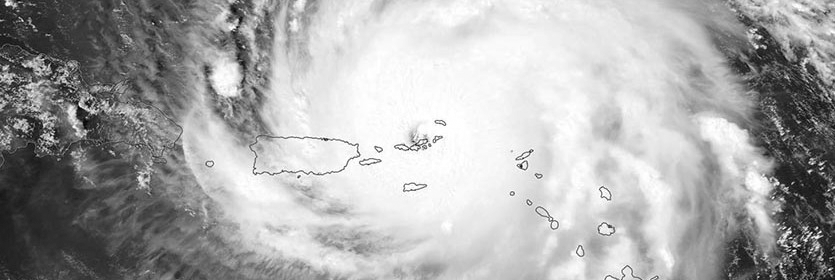
Trump Cites Puerto Rico’s Debt, Threatens to Revoke FEMA

nasa_irma_puerto rico

Rarely can political issues be fairly described as “black-and-white.” As with many facets of life, there’s no singular answer to questions about healthcare, tax reform or gun control.

There isn’t just one right approach to improving public education. There isn’t just one correct way to handle illegal immigration, or diplomacy. These are nuanced issues with wide-ranging courses of action to consider, and they are always further complicated by the furious slurry of competing opinions and perspectives.

Puerto Rico’s current crisis, however, is not one such issue.

Read more

Covfefe for Kathy

Kathy Griffin was shunned by CNN, Macy’s and the Internet earlier yesterday for a grotesque video which depicted Kathy holding Donald Trump’s severed head. Outrage was nigh immediate, garnering pissed off tweets from the Right and Left alike.
This whole issue is ridiculous. Here’s my thing: this wouldn’t be news if South Park had done the same thing.
I’m not sure if that makes it okay as satire in general. Perhaps it’s because South Park is animated, and everything is so hyper exaggerated and cartoonish that gore and violence depicting celebrities and public officials — in satire — is easier to accept. But why is that the case? Maybe it isn’t okay at all! But maybe it is… as long as you are funnier than Kathy Griffin.
Which is not all that difficult.
What I found more interesting about the news that day was Trump’s hilarious typo, “covfefe.” It first ushered confusion. In quick pursuit came memes and laughter, from Trump supporters and dissidents alike. The apparent spelling blunder was trending with the best of tweets by noon that day, with Twitter users sharing their own clever (and some not-so-clever) #covfefe jokes.
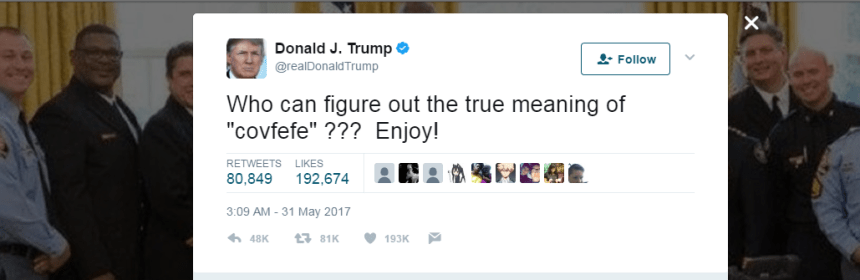
Even President Trump joined in the fun. He demonstrated a nigh unprecedented ability to poke fun of himself when he addressed the typo later that night (3:09 a.m. late, to be precise). “Who can figure out the true meaning of “covfefe” ??? Enjoy!” reads his tweet.
Yes, it was a fun moment in an otherwise worrisome and “unpresidented” first term. Fun, at least, until Reality came slinking back from the shadows of the collective unconsciousness and back into the center of everyone’s minds, ringing a bell and shouting about “implications.”

Let’s Talk About the Freakin’ Panama Papers

The Panama Papers controversy is a crazy phenomenon. It is arguably the best example of the power of information technology. The Panama Papers is the single largest data leak in human history. The Panama Papers consist of 2.6 terabytes of information—to put that into perspective, I Googled how many gigabytes were in 2.6 trillion terabytes, and Google didn’t even answer me. The next largest offshore data leak is just less than a quarter of its size, which itself is slightly larger than the infamous Snowden leaks. Read more